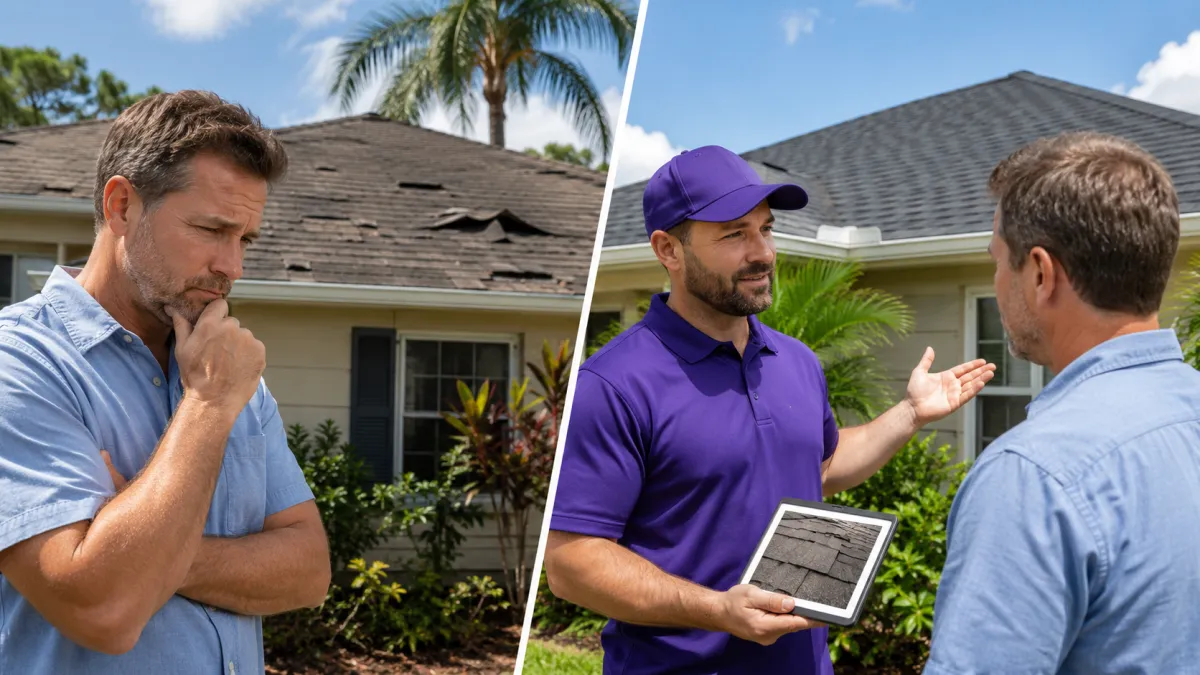
Roof Rejuvenation vs. Roof Replacement: Which Makes Sense for Your Florida Home?
Florida homeowners are often presented with roof replacement as if it is the only serious option. The roof is aging, the shingles look worn, the home is in a tough climate, and the recommendation comes quickly: replace it.
Sometimes that recommendation is correct.
But not always.
The problem is that many homeowners are not given a balanced explanation of their options. They are not told when roof rejuvenation may be worth considering. They are not told when preservation is unrealistic. They are simply pushed toward the most expensive decision first.
A smarter approach is to compare roof rejuvenation vs roof replacement based on condition, risk, cost, timing, and long-term goals.
What roof replacement does
A full roof replacement removes the existing roofing system and installs a new one. When a roof is failing, leaking extensively, structurally compromised, or beyond preservation, replacement may be the right move.
Replacement provides a full reset. It can address widespread deterioration, severe damage, and end-of-life conditions.
But it is also expensive, disruptive, and not always necessary at the first sign of age.
That is why homeowners should not treat replacement as automatic just because a roof is older.
What roof rejuvenation does
Roof rejuvenation is designed for certain asphalt shingle roofs that are aging but still structurally sound. The goal is to help restore flexibility and support the roof’s ability to continue performing.
As shingles age, they can dry out and become brittle. In Florida, heat and UV exposure can accelerate that process. A rejuvenation treatment may help qualified shingles regain some flexibility and extend useful life.
But it is not a new roof. It is not a structural repair. It is not appropriate for every roof.
The roof must qualify.
When roof rejuvenation may make sense
Roof rejuvenation may be worth considering when:
the roof is structurally sound,
the shingles are aging but not destroyed,
there are no major active leaks,
the decking is not compromised,
the homeowner wants to delay premature replacement,
and a professional roof inspection confirms eligibility.
This is especially relevant for homeowners who have an aging asphalt shingle roof but do not yet have evidence that full replacement is necessary.
When replacement may be the better answer
Replacement may be necessary when:
the roof has widespread active leaks,
decking is soft or damaged,
shingles are severely deteriorated,
storm damage is extensive,
prior repairs have failed repeatedly,
or the roof is clearly at end of life.
In those situations, trying to preserve the roof may be a bad decision. Preservation only works when the roof still has something left to preserve.
That is why honest evaluation matters.
The role of inspection
The most important step in this decision is a professional roof inspection. Without it, the homeowner is guessing.
A good inspection should look at shingle condition, granule retention, flexibility, roof penetrations, flashing details, previous repair zones, signs of water intrusion, ventilation concerns, and overall roof performance.
Only after that evaluation should the homeowner compare preservation and replacement.
Why cost should not be the only factor
Roof rejuvenation typically costs less than full replacement, which is one of the reasons homeowners are interested in it. But cost alone should not drive the decision.
A low-cost preservation treatment on the wrong roof is still a bad investment. A full replacement on a roof that still has viable life may also be an unnecessary expense.
The best decision is not automatically the cheapest or most expensive. It is the one that fits the roof’s actual condition.
How Roof Saver Florida helps homeowners choose
Roof Saver Florida helps homeowners move away from panic-based decisions. The goal is to evaluate the roof and determine whether the homeowner needs repair, preservation, monitoring, or replacement planning.
This matters because many homeowners are not trying to avoid reality. They are trying to avoid unnecessary replacement.
A condition-based approach protects the homeowner from both extremes: replacing too early or waiting too long.
Final thought
The question is not whether roof rejuvenation is always better than roof replacement. It is not. The question is whether your specific roof qualifies for preservation or whether replacement is truly necessary.
Florida homeowners deserve that answer before spending thousands of dollars.
Ready to find out whether your roof needs replacement or qualifies for preservation? Visit stoproofreplacement.com to schedule your roof inspection with Roof Saver Florida.
If you want to learn more about Roof Saver Florida and the products behind our roof preservation approach, visit Roofsavermagazine.com.


