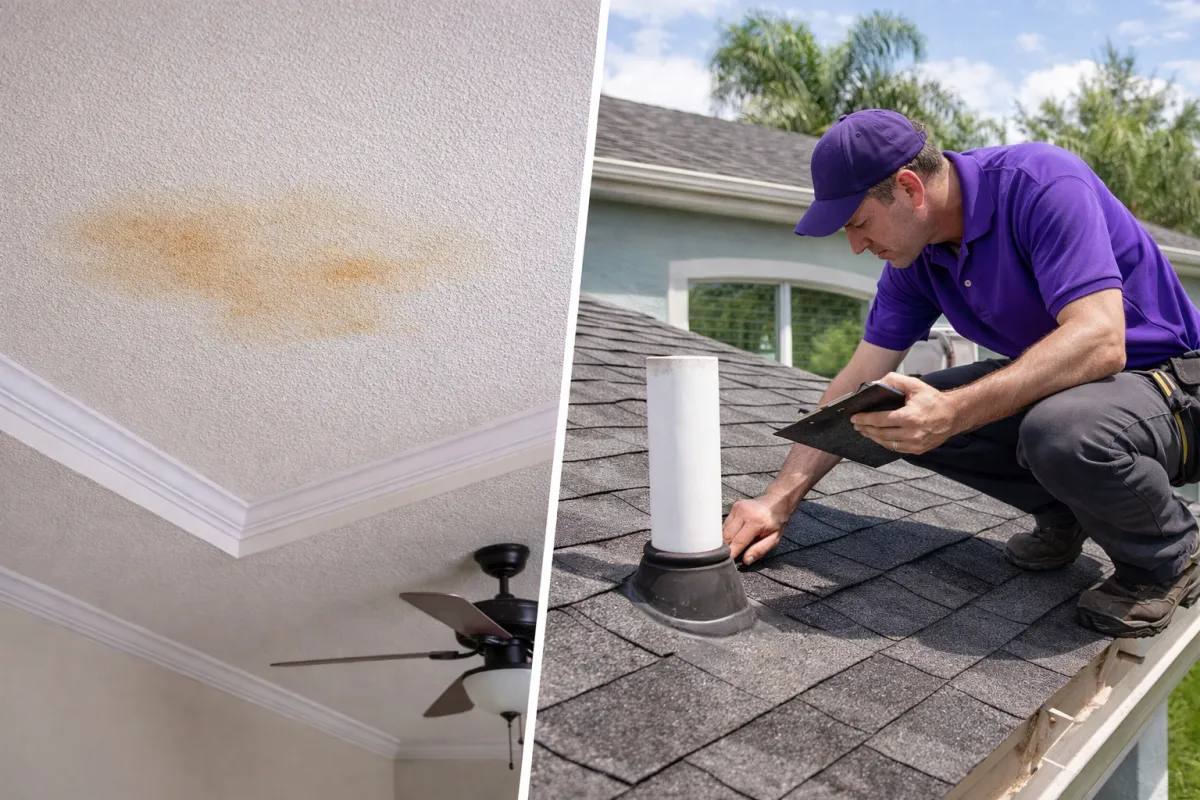
Roof Leaks Around Plumbing Vents in Longwood Homes: What Causes Them?
When homeowners think about roof leaks, many imagine missing shingles, storm damage, or major structural failure. In reality, some of the most frustrating leaks start at much smaller and more specific points in the roofing system. One of the most common examples is the plumbing vent.
In Longwood homes, leaks around plumbing vents are a serious issue because they often begin quietly, remain misunderstood, and get misdiagnosed. A homeowner may see a ceiling stain, moisture in the attic, or water appearing during a heavy rain and assume the entire roof is going bad. Sometimes the roof may indeed have broader issues, but very often the actual source is a vulnerable penetration detail around the plumbing vent.
That distinction matters. If you misdiagnose the source of the leak, you can spend money in the wrong place, delay the right fix, and allow more damage to build up over time.
What is a plumbing vent and why is it a weak point?
A plumbing vent pipe extends through the roof to allow proper air flow in the plumbing system. Because it passes through the roof covering, it creates a penetration point. Every roof penetration introduces complexity. The roofing system must seal and transition correctly around that opening, and that transition area is naturally more vulnerable than uninterrupted sections of roof.
That vulnerability usually involves the surrounding flashing, vent boot, seal, or the roofing materials immediately around the pipe. Over time, those components are exposed to sun, heat, rain, wind, thermal expansion, and normal aging. In Longwood, Florida weather can accelerate wear at these transition points. That means a plumbing vent may remain watertight for years and then gradually become one of the first leak sources on the roof.
Why leaks around plumbing vents are so common
There are several reasons these leaks show up so often:
1. The vent boot ages faster than homeowners realize
The boot or protective component around the vent pipe is exposed constantly. UV, heat, and weather can dry out or weaken materials over time.
2. Flashing details can fail
If flashing was poorly installed, deteriorates with age, or becomes compromised by movement, water can begin entering around the vent area.
3. Sealants are not permanent solutions
If a previous contractor relied heavily on sealants instead of proper detailing, those materials may eventually crack, separate, or fail under Florida conditions.
4. Water does not always show up directly under the source
One of the reasons plumbing vent leaks are confusing is that water can travel. The ceiling stain may appear several feet away from the actual entry point.
5. Homeowners often overlook small penetration problems
A roof may look mostly fine from the ground, which leads the homeowner to assume the leak must be random or mysterious. In reality, the issue may be a focused failure around a vent.
Signs that a plumbing vent may be the source of the leak
Longwood homeowners should pay attention to several common warning signs:
ceiling stains near bathrooms, hallways, or interior plumbing-related zones,
intermittent leaks during heavy rain,
moisture in the attic near roof penetrations,
discoloration or staining on decking near the vent area,
and recurring leaks that seem to have been “fixed” before but keep returning.
Leaks around plumbing vents often fool homeowners because they may appear small and sporadic at first. That can create a false sense of security. Then a stronger storm comes through, water enters more aggressively, and the problem suddenly feels urgent.
Why misdiagnosis is expensive
One of the most common failures in roofing service is not technical skill. It is diagnostic laziness.
Some contractors see a leak and immediately blame shingles. Others apply surface patch materials without isolating the true source. Still others jump straight to recommending broader replacement because it is easier to sell a big job than to investigate a focused one.
That approach is expensive for the homeowner.
If the true problem is a vent boot, flashing detail, or localized penetration failure, then broad shingle work alone will not solve the root issue. Water may still enter, damage may continue, and the homeowner ends up paying twice: once for the wrong work and again for the work that should have been done the first time.
Why Longwood homeowners should not delay inspection
Small roof leaks do not stay small forever. That is one of the most dangerous assumptions homeowners make. A leak around a plumbing vent may seem minor because it appears only during heavy rain or because the visible stain is limited. But continued water intrusion can affect decking, attic conditions, insulation, drywall, paint, and in some cases indoor air quality.
What begins as a localized roof problem can become an interior damage issue. And once interior restoration gets added to the equation, the cost and complexity rise fast.
That is why timely roof inspection matters. The goal is not to panic. The goal is to catch the issue while it is still manageable.
How Roof Saver Florida approaches this kind of problem
Roof Saver Florida’s value in this scenario is the inspection-first mindset. When a leak appears near a plumbing vent, the correct question is not “How big of a job can we sell?” The correct question is “Where is the water actually entering and what condition is the surrounding system in?”
That means evaluating:
the vent penetration itself,
surrounding flashing,
nearby shingles or roofing materials,
signs of prior patchwork,
attic evidence,
and whether the leak is isolated or part of a broader pattern.
That kind of approach helps homeowners avoid both underreaction and overreaction.
Why penetration details matter in roof health overall
One of the broader lessons here is that roofs do not fail only in wide open fields of shingles. They often fail first at transitions, penetrations, terminations, valleys, flashing points, and edges. Plumbing vents are just one example of that larger principle.
That is why a real roof evaluation looks at the system as a system. It does not focus only on what is obvious from the ground. It pays attention to details that often drive leakage first.
For Longwood homeowners, that means understanding that a leak around a vent does not automatically mean the whole roof is done. But it also means recognizing that a localized leak deserves real attention, not guesswork.
Final thought
Roof leaks around plumbing vents in Longwood homes are common for a reason. Penetration points are vulnerable, aging materials can fail, and water can find its way into the roof system long before the homeowner fully understands what is happening.
The worst move is assuming the problem will go away or letting someone guess at the source. The best move is a proper inspection that identifies where the water is entering and what the roof actually needs.
Ready to get clarity on your roof? Visit stoproofreplacement.com to schedule your roof inspection with Roof Saver Florida.
If you want to learn more about Roof Saver Florida and the products behind our roof preservation approach, visit Roofsavermagazine.com.


