Roof Rejuvenation: What It Is, How It Works, Costs, Pros & Cons (Florida Homeowner Guide)
In Florida, roof replacement has become one of the most stressful and expensive decisions a homeowner can face. Material prices are high, labor is expensive, insurance conversations are harder than they used to be, and many homeowners feel like they are being pushed into full replacement before they fully understand their options.
That is why more homeowners are asking about roof rejuvenation.
The problem is that this topic is often explained poorly. Some companies oversell it like a miracle cure. Others dismiss it completely because they only want to sell full roof replacements. Both extremes are weak. If a homeowner is going to make a smart decision, they need a clear explanation of what roof rejuvenation actually is, how it works, what it does well, where it falls short, and when it may or may not make sense in a Florida market.
That is what this guide is for.
Why roof rejuvenation is getting attention in Florida
Florida is one of the hardest environments in the country for asphalt shingle roofs.
Roofs here deal with:
intense UV exposure,
high heat,
humidity,
algae and biological growth,
seasonal heavy rain,
and storm-related wind stress.
Those conditions accelerate the aging process. Over time, shingles dry out, become more brittle, and lose some of the flexibility they had when they were newer. Once that happens, the roof becomes more vulnerable to cracking, weathering, and performance decline.
At the same time, homeowners are facing a second pressure: cost. Full roof replacement is expensive, disruptive, and not always financially convenient when the roof is aging but not necessarily at total failure.
That is where roof rejuvenation enters the conversation.
For many Florida homeowners, it is being considered not as a magic trick, but as a roof preservation strategy.
What roof rejuvenation is
At its core, roof rejuvenation is a treatment process designed to help extend the life of an existing asphalt shingle roof by addressing one of the biggest reasons shingles age: loss of flexibility.
As shingles age, they lose oils and begin to dry out. In a climate like Florida, this process can happen faster because the roof is constantly exposed to heat and sun. As flexibility decreases, the shingles become more brittle and more vulnerable to wear.
The purpose of roof rejuvenation is to help restore flexibility and improve the condition of aging shingles, assuming the roof is still structurally sound and still qualifies for that type of preservation approach.
That distinction matters.
What roof rejuvenation is not
One of the biggest sources of confusion in the market is that many homeowners hear the term and assume it means more than it does.
Roof rejuvenation is not:
a full roof replacement,
a fix for structural failure,
a solution for rotten decking,
a cosmetic paint job,
or a miracle cure for a roof that is already done.
That matters because a lot of homeowner disappointment comes from bad expectations. If someone applies a rejuvenation treatment to a roof that is already beyond the point of preservation, the problem is not the concept itself. The problem is that the roof should not have been treated as a candidate in the first place.
A roof needs to qualify.
How roof rejuvenation works
The exact process depends on the technology being used, but the logic is straightforward: evaluate the roof, prepare the surface correctly, apply the treatment evenly, and allow the material to absorb and cure properly.
Here is the process in a practical sequence.
1. Start with a professional roof inspection
This is the most important step.
Before anyone discusses roof rejuvenation, the roof should go through a real roof inspection and eligibility review. Not every roof qualifies, and pretending otherwise is irresponsible.
A roof evaluation should look at:
overall roof age,
current shingle condition,
granule retention,
signs of brittleness,
active leak history,
flashing and penetration issues,
structural concerns,
and whether the roof still has meaningful service life left.
If the roof is already failing structurally, heavily deteriorated, or suffering from major leak-related damage, rejuvenation is not the right answer.
2. Prepare the roof surface properly
Cleaning is not optional. It is critical.
If a roof surface is covered with algae, organic buildup, dirt, or debris, that material can interfere with proper absorption and treatment performance. That is why surface preparation is often a required step before treatment is applied.
In many cases, that means a professional soft wash or cleaning process designed to prepare the shingles without causing unnecessary damage.
Skipping the cleaning stage weakens results. That is one of the reasons poor applications lead to bad homeowner experiences.
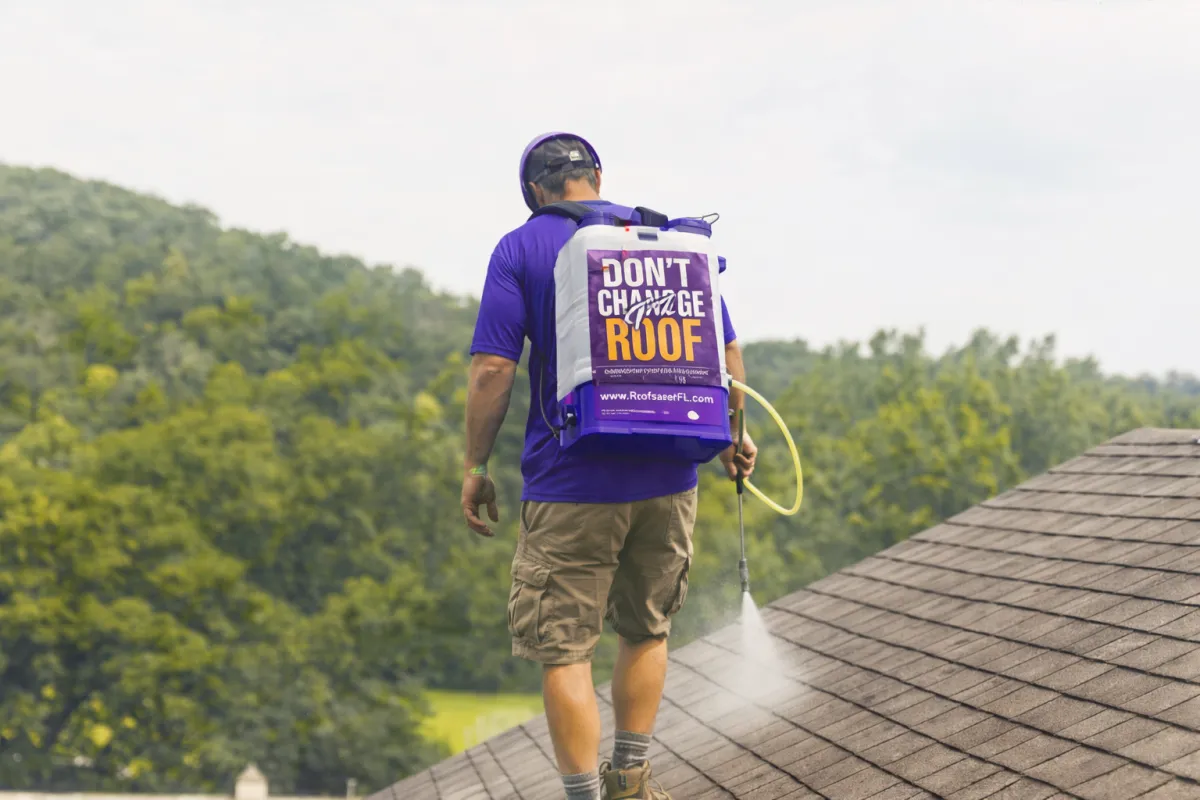
3. Apply the treatment evenly
Once the roof has been evaluated and prepared, the rejuvenation solution is applied across the roof surface.
Different systems use different chemistry. Some rely on oil-based solutions. Some use emulsions. Some use more advanced nanotechnology-driven systems. The goal is not simply to coat the roof visually. The goal is to allow the treatment to interact with the shingle material in a way that supports restored flexibility and better performance.
This is why product choice matters. Not all roof rejuvenation systems are equal.
4. Allow absorption and curing
After application, the treatment needs time to absorb and cure properly.
When the right roof is treated correctly, the intended outcome is an improvement in shingle pliability and an increase in the roof’s ability to continue performing as it ages. Depending on the system, treatment may also help support better resistance to UV exposure and environmental stress.
But again, this only matters if the roof was a real candidate and the process was done correctly.
What roof rejuvenation is made of
This is where many homeowners get confused, because “roof rejuvenation” is not one single universal formula.
There are different categories of products used in the market.
Oil-based treatments
These are designed to replenish lost oils in aging shingles. Some may use bio-based or petroleum-derived materials. They can be effective, but performance depends heavily on product design, absorption, and application quality.
Emulsion-based systems
These may combine water, oils, and other binding agents. Some function more like surface-oriented treatments or sealants than deeper restorative systems. Not all of them perform the same way.
Nanotechnology-based treatments
These are typically positioned as more advanced systems designed to penetrate more deeply and create molecular-level benefits rather than just sitting on the surface. This is especially relevant when homeowners are comparing preservation quality rather than just price.
The key lesson is simple: the technology matters more than the marketing language.
Does roof rejuvenation actually work?
Yes, roof rejuvenation can work when three conditions are true:
the roof is a legitimate candidate,
the right system is used,
and the application is done by trained professionals.
That is the honest answer.
It works because asphalt shingles do not usually fail for only one reason. Over time, they lose oils, become brittle, and degrade under UV and weather exposure. A preservation system designed to improve flexibility and support aging shingles can help slow that process when the roof still has enough life left to justify it.
But homeowners should stay grounded.
Roof rejuvenation does not:
reverse severe granule loss,
fix rotten decking,
repair structural sagging,
or turn a failing roof into a new one.
Whenever a contractor presents it as a miracle cure, that is a red flag.
The pros of roof rejuvenation
There are real reasons homeowners in Florida are interested in this.
1. Lower cost than replacement
One of the biggest advantages of roof rejuvenation is cost. In many cases, it costs a fraction of what a full roof replacement would cost.
That matters in Florida because homeowners are already dealing with high ownership costs, insurance pressure, and repair inflation.
2. Potentially extended roof life
When applied correctly to the right roof, roof rejuvenation may help extend the useful life of the roof by several years. The exact outcome depends on roof age, condition, climate exposure, and the treatment technology being used.
3. Less disruption
A full replacement is noisy, messy, time-consuming, and operationally disruptive. Roof rejuvenation is typically much less invasive. There is no tear-off, no dumpster, less debris, and far less interruption to the homeowner.
4. Preservation mindset
Some homeowners do not want to replace materials prematurely if the roof is still structurally viable. From that perspective, roof rejuvenation fits into a preservation strategy rather than a replace-first model.
5. Better financial flexibility
Even when replacement may eventually be necessary, preserving roof performance now can create breathing room. That flexibility matters for homeowners who need time to plan larger capital decisions more intelligently.
The cons of roof rejuvenation
A serious guide has to include the downsides too.
1. Not every roof qualifies
This is the biggest limitation. If the roof is too far gone, rejuvenation is not the answer.
2. Results depend on preparation and application
Poor cleaning, rushed application, low-quality products, or weak evaluation practices can all reduce results. This is not a DIY shortcut.
3. It does not reset the roof to brand-new condition
A lot of homeowners need to hear this clearly: roof rejuvenation extends life. It does not reset the clock to zero.
4. The market has misinformation
Some products are oversold. Some contractors are undertrained. Some homeowners hear conflicting claims and do not know what to believe. That makes contractor selection extremely important.
Roof rejuvenation vs roof replacement
This is where homeowners need strategic thinking.
A full replacement may be the right answer when the roof is structurally failing, leaking extensively, or clearly beyond preservation.
But if the roof is still structurally sound and the issue is aging rather than collapse, roof rejuvenation may serve as a bridge strategy.
That is a useful way to think about it.
Replacement is a full reset, but it is expensive and disruptive.
Roof rejuvenation is a preservation-oriented option that may extend service life at a much lower cost, but it is not permanent and it is not appropriate for every roof.
This is not an either-or religion. It is a decision framework.
How much roof rejuvenation costs in Florida
Pricing varies based on:
roof size,
roof pitch,
roof condition,
the treatment technology,
and the amount of preparation required.
In general, homeowners often look at roof rejuvenation because it is substantially more affordable than full replacement.
That price difference is one of the biggest reasons the topic is gaining traction in Florida. When replacement is expensive and the roof may still have viable life left, homeowners naturally start looking for preservation strategies that make financial sense.
The key is not to choose based on price alone. The key is to compare price against roof condition and expected outcome.
When roof rejuvenation is worth considering
A homeowner should consider roof rejuvenation when:
the roof is structurally sound,
the shingles are aging but not failing catastrophically,
there is no major widespread leak or deck failure,
the goal is to extend useful life,
and the homeowner wants a lower-cost alternative to immediate full replacement.
This is especially relevant in Florida where the environment accelerates aging and the financial burden of roof replacement can be steep.
When it is probably not worth it
A homeowner should be cautious if:
the roof has major structural issues,
decking is compromised,
widespread active leaking is present,
shingles are severely deteriorated,
or the roof is already clearly at end-of-life.
In that scenario, forcing roof rejuvenation onto the wrong roof is not strategic. It is denial.
Why Florida homeowners need professional guidance
Florida roofs face too much environmental stress for this decision to be made casually.
The state’s climate means:
product selection matters,
surface preparation matters,
professional application matters,
and above all, roof inspection matters.
A homeowner should not choose based on a buzzword. They should choose based on the actual condition of the roof and the credibility of the company evaluating it.
That is where a company like Roof Saver Florida becomes relevant. The value is not only in offering roof preservation options. The value is in helping the homeowner understand whether the roof is a real candidate and what path makes the most sense based on evidence.
Final thought
Roof rejuvenation is not about avoiding reality. It is about making a smarter decision before jumping to the most expensive one.
For many Florida homeowners, it can be a practical preservation strategy that creates time, flexibility, and financial breathing room. But only when the roof qualifies, the right system is used, and the process is done correctly.
The wrong move is believing every roof needs replacement just because it is aging.
The other wrong move is believing every roof can be saved.
The smart move is getting a real roof inspection, understanding the roof’s condition, and choosing the option that actually fits the evidence.
Ready to get clarity on your roof? Visit stoproofreplacement.com to schedule your roof inspection with Roof Saver Florida.
If you want to learn more about Roof Saver Florida and the products behind our roof preservation approach, visit Roofsavermagazine.com.


