What Granule Loss Means for Your Florida Roof
If you have ever cleaned your gutters and found small sandy particles inside, you may have seen roof granules. If you have noticed dark or shiny patches on your shingles, you may also be seeing signs of granule loss.
For Florida homeowners, this can be concerning. Does granule loss mean the roof needs replacement? Is it normal? Is it dangerous? Should you call someone immediately?
The answer depends on the amount of granule loss, the age of the roof, and the overall condition of the shingles.
Granule loss should not be ignored, but it also should not automatically create panic.
What roof granules do
Asphalt shingles are covered with granules for a reason. These granules help protect the shingle from sunlight, UV exposure, weather, and surface wear.
In Florida, that protection is especially important because roofs are exposed to intense sun and heat. Without granules, the asphalt layer becomes more vulnerable to drying, cracking, and aging.
This is why granule loss can be an important sign of roof condition.
Is some granule loss normal?
Yes, some granule loss can be normal.
New roofs may shed loose granules after installation. Older roofs may lose granules gradually over time. Some granules may collect in gutters or downspouts after heavy rain.
The issue is not whether any granules are present. The issue is how much loss there is, where it is happening, and whether it is part of a larger deterioration pattern.
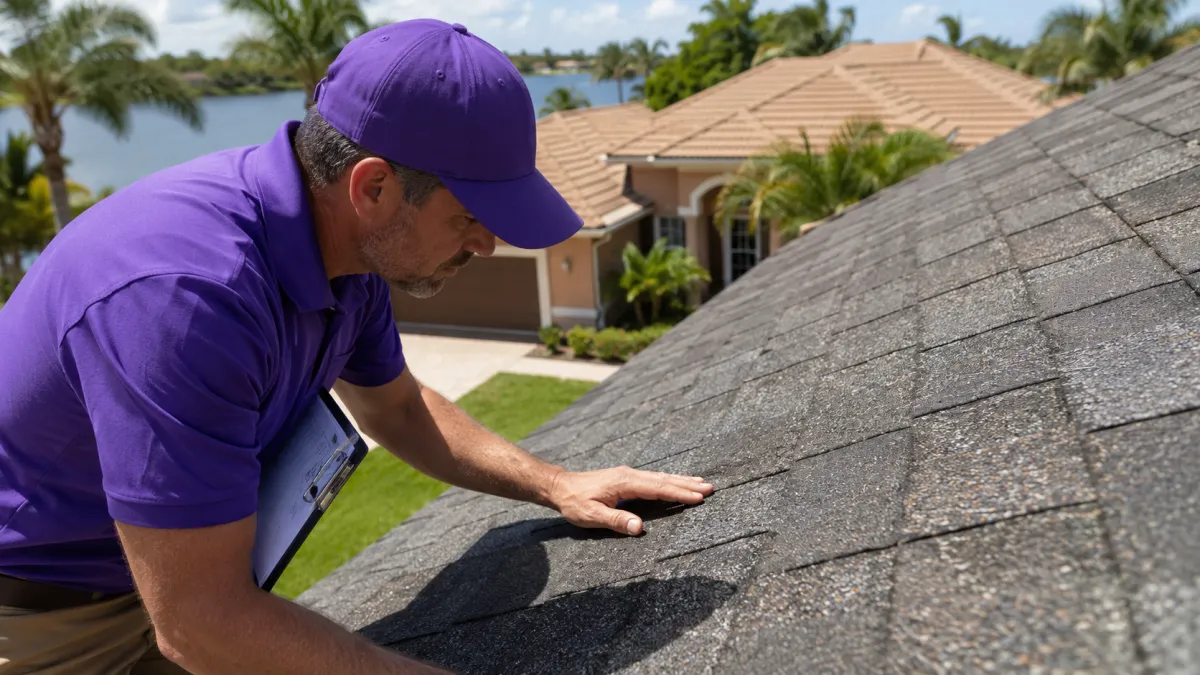
That is why a professional roof inspection matters.
When granule loss becomes serious
Granule loss may be more concerning when:
shingles show bald spots,
granules are collecting heavily in gutters,
the roof has uneven wear patterns,
shingles look shiny or exposed,
there are cracked or curled shingles,
or the roof is already aging.
If granule loss is widespread, the roof may be losing its protective surface. That can accelerate deterioration.
In Florida, this matters because UV exposure is strong. Once shingles lose protection, they can dry out faster and become more brittle.
Does granule loss mean replacement?
Not always.
This is where homeowners need to be careful. Some contractors may use granule loss as a reason to push replacement immediately. In some cases, replacement may be the right answer. But in other cases, the roof may need monitoring, maintenance, or a preservation discussion.
The correct answer depends on the roof’s actual condition.
A roof with minor localized granule loss may not need replacement. A roof with severe widespread granule loss and brittle shingles may be near the end of its useful life.
The point is simple: do not make a major decision based on one sign alone.
Granule loss and roof rejuvenation
If granule loss is not too advanced and the roof is still structurally sound, roof rejuvenation may be worth discussing. Rejuvenation is not designed to replace missing granules, but it may help improve flexibility in aging shingles and support a broader preservation strategy.
However, if granule loss is severe, the roof may no longer be a good candidate.
This is why Roof Saver Florida starts with inspection. The roof has to be evaluated before a responsible recommendation can be made.
Why Florida makes granule loss worse
Florida’s climate can accelerate roof wear.
Heat, UV rays, humidity, heavy rain, algae, wind, and storm activity all affect the roof over time. A roof in Florida may age differently than the same roof in a milder climate.
This is why homeowners should be proactive. Waiting until the roof looks obviously damaged may reduce options.
Early roof inspection gives the homeowner more choices.
What homeowners should do if they see granules
If you notice granules in gutters or downspouts, do not panic. But do not ignore it either.
The smart step is to schedule a roof inspection. A professional can determine whether the granule loss is normal, moderate, or serious.
You should also look for related signs:
cracked shingles,
curling,
exposed areas,
dark patches,
leaks,
and loose shingles.
Granule loss is one clue. The full roof condition tells the real story.
Final thought
Granule loss is one of the most important signs of asphalt shingle aging, especially in Florida.
It does not always mean your roof needs replacement today. But it does mean your roof deserves attention.
The smartest move is to get clarity before the problem becomes more expensive. A professional roof inspection can help determine whether your roof needs maintenance, preservation, or replacement planning.
Ready to get clarity on your roof? Visit stoproofreplacement.com to schedule your roof inspection with Roof Saver Florida.
If you want to learn more about Roof Saver Florida and the products behind our roof preservation approach, visit Roofsavermagazine.com.


